

She had the orthotics. She had the shoes. She'd done the stretches every morning for eight months.
And she still couldn't walk her dog.
She was 61, she'd been my patient for two years, and by every conventional measure of my profession I had followed the standard playbook. I had also completely failed her.
If you've bought three pairs of supportive shoes and still wake up stiff — if you've been told it's wear and tear, or your weight, or just your age — if you've noticed that resting somehow makes it worse instead of better — then what I'm about to tell you may explain a great deal.
Because the problem may not be the structure of your feet.
Eleven years of treating the wrong thing
I'd been a podiatrist for eleven years when that woman sat in my office and told me she'd stopped taking the dog out. Eleven years, mostly women, mostly over fifty. And for all of it I had done exactly what I was trained to do.
Feet are a structural problem. So you solve them structurally — arch support, heel cups, cushioning, motion control, custom orthotics moulded to the individual foot. It works beautifully for a collapsed arch, for a mechanical fault, for a foot that's built wrong or wearing wrong.
Hers was none of those things. Her arches were fine. Her gait was fine. Her X-rays were unremarkable. And she was one of the hardest cases I had.
That is not what should happen. So after she left I pulled her chart, and then I pulled the charts of every other woman who had done everything right and still hadn't improved.
There were more of them than I expected, and they had something in common I'd never once thought to record. They were almost all women between about forty-eight and sixty-five. The ones whose feet looked worst on paper had mostly done well. The ones I'd failed had feet that looked fine.
The question that isn't on any intake form
So I started asking every woman over forty-five who came through my door one question.
When did you go through menopause?
The pattern was immediate and it was ugly. Over and over, the stiffness had started within a few years of it. Some of them could name the month.
Not one of them had ever been told the two might be connected. Not by me. Not by their GP. Not by anyone.
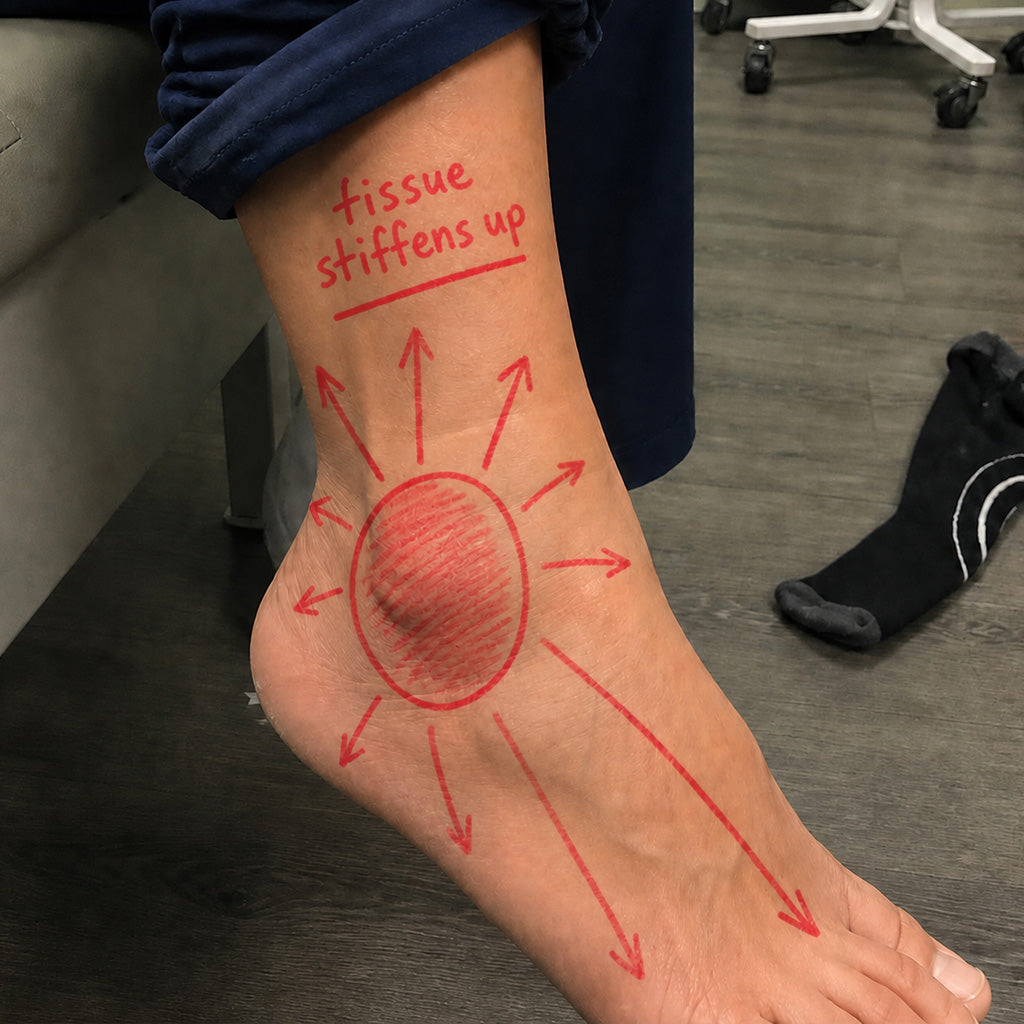
Estrogen does a great deal more than most people realize. Among other things it helps maintain the elasticity of connective tissue — the tendons, the ligaments, the fascia running through every joint in your body. When estrogen drops at menopause, that tissue gets stiffer and less pliable. And it shows up first in whichever joints have taken the most punishment over a lifetime.
For most women that means the ankles and feet. They've carried you for sixty years. They go first.
So the woman who did everything right and got worse anyway wasn't failing at her exercises. She was being treated for a structural problem she didn't have.
Why the shoes and the inserts couldn't help
Once I understood that, the failures in my own records made sense for the first time.
Orthotics change how your foot is supported. They do nothing about tissue that's lost its give, and they only work while you're standing in them. Cushioned shoes, the same — genuine relief while you're walking, nothing at all for the stiffness waiting at six in the morning before your feet have touched the floor. Arch supports, heel cups, gel inserts are all aimed at the mechanics of the arch.
Stretching is the exception, and it's the closest anyone gets, because it does work directly at the tissue. But most women are stretching a cold, stiff joint, and it hurts enough that they stop.
The woman with the dog didn't stop. Eight months, every morning. And it still wasn't enough — because she was working at tissue that was never warm enough to give.
The two things stiff tissue actually responds to
Here's the part that made me feel foolish, because it isn't complicated. It's the oldest knowledge in physical medicine.
Stiff tissue responds to warmth, and to gentle movement.
Warmth makes tissue more pliable — it's why you're looser after a hot shower, and why every physiotherapist warms a joint before working on it. And gentle movement keeps that tissue from settling and setting, which is exactly why sitting still all evening leaves you stiffer than when you sat down.
Warmth and movement, together, applied to the joint itself rather than the shoe underneath it. That's the whole answer.
In clinic that's routine. We warm a joint, then we mobilize it, and twenty minutes later a woman walks out looser than she came in.
What they were using in between — and why it wasn't working
So I started asking, and the answers came back as the same three things.
A heating pad gave them warmth, but it's corded and flat and will not stay wrapped around the curve of an ankle. Most of them ended up holding it in place by hand. A massage gun gave them movement, with no warmth at all, and they had to hold it and aim it and keep it there with hands that had their own stiffness. A foot spa briefly gave them both, but only to the soles, and it left a basin to empty and a floor to mop.
Not one of them delivered warmth and gentle movement together, at the ankle, without turning into another job at the end of a long day.
What these women needed was something closer to what happens in my clinic, in a form they'd actually use twice a day without thinking about it. Warmth and gentle massage at the same time. Wrapped around the ankle so it stays where it's put. Cordless, so it isn't a decision about which chair to sit in. And entirely hands-free.
I said as much to the woman with the dog, without much hope that such a thing existed.
She came back six weeks later with one
She'd gone looking herself and found a heated ankle wrap — a Lanarie ReadyStep. Heat and gentle vibration at the same time, cordless, wrapping right around the joint, with an automatic shut-off so she could put it on before she got out of bed and not have to think about it.
She'd bought a single one, for the right ankle, which had always been the worse of the two. She told me she wasn't spending money on a pair of anything again until something actually worked.
She'd been using it morning and evening. The first thing she told me was that she wasn't sitting on the edge of the bed as long.
She's walking the dog again. Not the full route, and not every day. But she does it in the mornings now, which is something she hadn't done in over a year.
Lanarie ReadyStep — Heated Ankle Wrap
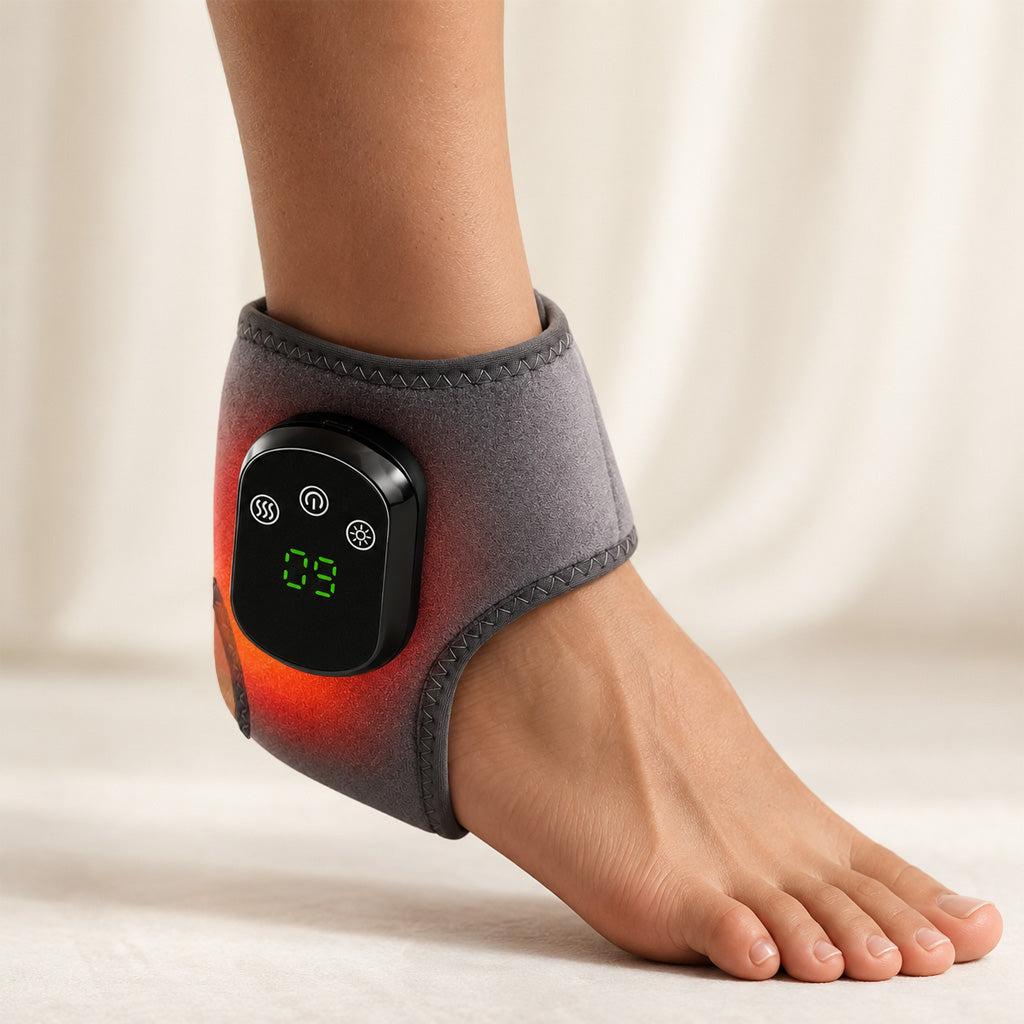
The design is what convinced me. It does both halves at the same time — warming the tissue while something gently works at it — which is, more or less, what I do to a joint in clinic, except she could do it in her own chair.
- Warmth and gentle massage together, in one wrap
- Wraps the ankle and stays put — no flat pad sliding off
- Cordless, so you're not tied to a wall socket
- Entirely hands-free — nothing to hold or aim
- Shuts itself off after 30 minutes
One patient isn't evidence
But it was enough to make me pay attention, so I went back to the reasoning behind local heat and gentle mobilization — something I'd been using in clinic for a decade without ever once thinking to ask what my patients could do with it at home.
Then I started mentioning it. Not as a treatment, and not to everyone. To the women whose feet were structurally sound and stubbornly stiff, as something to try in the evenings.
They came back and told me the same things she had. Mornings, mostly. Getting up out of a chair.
What it does, and what it doesn't
I want to be plain about the limits, because my profession has oversold enough to these women already.
Warmth and massage do not replace the estrogen you've lost. They don't rebuild tissue and they won't give you the ankles you had at thirty, and anyone telling you otherwise is selling you something.
What they do is make stiff tissue temporarily more pliable — which, used consistently, is the difference between dreading the first step of the day and not thinking about it.
The part that still bothers me
The average woman I see has been living with this for six or seven years before anyone connects it to menopause, and plenty are never told at all. She's spent hundreds on shoes. She's sat in front of people like me. And in that time she's quietly given up the walk, the garden, the floor with the grandchildren, one small surrender at a time, believing it was simply age.
It usually wasn't only age. It was a change in her body that nobody bothered to explain, treated as a fault in her feet.
That isn't a failure of medicine's knowledge. All of this is in the literature. It's a failure of anyone thinking to tell her.
If you're stiff in the mornings and worse after sitting
And everyone has told you it's just your age — it may be worth trying the two things stiff tissue actually responds to.
The one my patients use is the Lanarie ReadyStep — a cordless heated ankle wrap that gives you warmth and gentle massage together, hands-free, with a thirty-minute automatic shut-off.
I tell the ones who are wary of spending more money on their feet — and most of them are, by the time they reach me — that it comes with ninety days to send it back. If it doesn't loosen those first steps, it costs you nothing to find out.
And if both ankles are stiff, get two. Treating them one at a time makes for a long evening.
Check ReadyStep Availability →